


Some books are popular for a season. Others stay with us for generations.
The best classic books have a remarkable ability to feel personal, even when they were written decades or centuries ago. They introduce us to unforgettable characters, challenge our assumptions, and explore questions about love, freedom, identity, and human nature that never really go away.
Whether you’re discovering classic literature for the first time or revisiting an old favorite, these 15 books deserve a place on your reading list.
What Makes a Book a Classic?
A classic isn’t simply an old or famous book. It’s a work that continues to connect with readers long after its original publication.
Some classics transformed literature. Others challenged social conventions or captured something universal about the human experience.
And while certain classics require patience, others are surprisingly accessible, entertaining, and impossible to forget.
“A great classic doesn’t just tell a story. It gives every new generation something different to discover.”
15 Classic Books Worth Reading
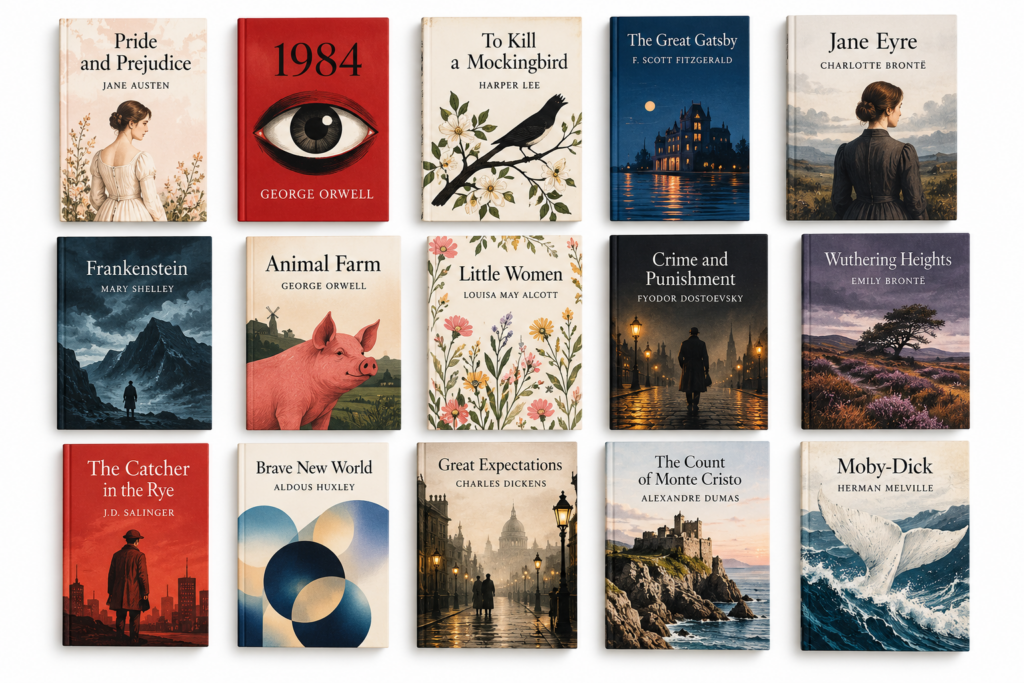
1. Pride and Prejudice — Jane Austen
Few novels combine romance, humor, and social commentary as brilliantly as Pride and Prejudice.
Set in 19th-century England, the story follows Elizabeth Bennet, an intelligent and independent young woman navigating family expectations, social class, and her complicated relationship with Mr. Darcy.
Beneath its romantic storyline, Austen explores first impressions, personal growth, and the danger of judging others too quickly.
Why read it: For its unforgettable characters, clever dialogue, and timeless exploration of love and prejudice.
2. 1984 — George Orwell
Published in 1949, 1984 imagines a frightening society where surveillance, propaganda, and political control shape every aspect of daily life.
Winston Smith lives under the watchful eye of Big Brother, struggling to preserve his individuality in a world where even independent thought is dangerous.
Orwell’s dystopian masterpiece raises powerful questions about truth, privacy, language, and freedom.
Why read it: It encourages readers to question authority, manipulation, and the relationship between information and power.
3. To Kill a Mockingbird — Harper Lee
Through the eyes of young Scout Finch, Harper Lee explores racial injustice, childhood innocence, and moral courage in the American South.
At the center of the novel is Atticus Finch, a lawyer defending a Black man falsely accused of a serious crime.
The story remains widely discussed not only for its message about empathy and justice, but also for the limitations of its perspective on race.
Why read it: For its memorable storytelling and the important conversations it opens about prejudice and responsibility.
4. The Great Gatsby — F. Scott Fitzgerald
Behind the glamorous parties and luxurious mansions of the Jazz Age lies a story about longing, obsession, and the American Dream.
Jay Gatsby has built an extraordinary life around the hope of winning back Daisy Buchanan. Yet his pursuit of an idealized past reveals the emptiness beneath wealth and status.
Why read it: It’s a beautifully written, relatively short novel about ambition, illusion, and the things money cannot buy.
5. Jane Eyre — Charlotte Brontë
Jane Eyre follows an orphaned young woman determined to build a life based on independence, dignity, and personal integrity.
Her journey leads her to Thornfield Hall, where she becomes a governess and develops feelings for the mysterious Mr. Rochester.
Combining romance, Gothic mystery, and personal growth, Brontë created a heroine who refuses to sacrifice her principles for love.
Why read it: For its strong female protagonist and enduring themes of self-respect and independence.
6. Frankenstein — Mary Shelley
Often mistaken for a simple horror story, Frankenstein is actually a thoughtful exploration of ambition, responsibility, and loneliness.
Victor Frankenstein creates a living being through scientific experimentation but abandons his creation when confronted with the consequences.
What follows is a tragedy shaped by rejection and the desperate desire to belong.
Why read it: Its questions about scientific responsibility and the treatment of outsiders remain strikingly relevant.
7. Animal Farm — George Orwell
On a farm where animals overthrow their human owner, dreams of equality gradually transform into a new form of oppression.
Orwell uses a deceptively simple story to examine propaganda, corruption, and the abuse of political power.
Despite its short length, Animal Farm delivers a powerful message about how revolutionary ideals can be manipulated.
Why read it: It’s one of the most accessible introductions to political satire and allegorical fiction.
8. Little Women — Louisa May Alcott
The four March sisters — Meg, Jo, Beth, and Amy — grow up facing different dreams, responsibilities, and expectations.
Through family relationships, personal ambitions, and everyday struggles, Little Women explores what it means to find your own path.
Jo March, in particular, has inspired generations of readers with her determination to become a writer.
Why read it: For its warmth, emotional depth, and honest portrayal of growing up.
9. Crime and Punishment — Fyodor Dostoevsky
After committing a murder, impoverished former student Rodion Raskolnikov becomes trapped in a psychological struggle with guilt, fear, and his own philosophical beliefs.
Rather than focusing only on the crime itself, Dostoevsky explores the emotional and moral consequences that follow.
Why read it: For its extraordinary psychological depth and challenging questions about morality, justification, and redemption.
10. Wuthering Heights — Emily Brontë
Set against the dramatic Yorkshire moors, Wuthering Heights tells a dark story of obsession, revenge, and destructive relationships.
The intense connection between Catherine Earnshaw and Heathcliff drives a narrative that stretches across generations.
This isn’t a conventional romance. It’s a complex exploration of how love, resentment, and social divisions can shape lives.
Why read it: For its Gothic atmosphere, complicated characters, and emotionally powerful storytelling.
11. The Catcher in the Rye — J. D. Salinger
Holden Caulfield, a disillusioned teenager, wanders through New York City while struggling with loneliness, grief, and the pressures of growing up.
His distinctive voice makes the novel feel unusually intimate, as though the reader is listening directly to his thoughts.
Why read it: For its memorable portrayal of teenage alienation and the difficult transition toward adulthood.
12. Brave New World — Aldous Huxley
In Huxley’s dystopian future, society maintains stability through technological conditioning, manufactured happiness, and carefully controlled social roles.
Unlike the world of 1984, oppression here often comes disguised as comfort and pleasure.
Why read it: It raises fascinating questions about individuality, consumerism, freedom, and the price of a perfectly controlled society.
13. Great Expectations — Charles Dickens
Pip, a young orphan, dreams of becoming a gentleman after receiving unexpected financial support.
As he enters a world of wealth and social ambition, he discovers that status and character are not necessarily connected.
Dickens combines mystery, humor, memorable characters, and social criticism in this coming-of-age story.
Why read it: For its exploration of ambition, class, loyalty, and the meaning of personal success.
14. The Count of Monte Cristo — Alexandre Dumas
Wrongfully imprisoned after a betrayal, Edmond Dantès eventually escapes and creates an elaborate plan to punish those responsible for destroying his life.
Filled with adventure, secrets, shifting identities, and dramatic revelations, the novel remains one of literature’s most entertaining revenge stories.
Why read it: For its gripping plot and its questions about justice, forgiveness, and revenge.
15. Moby-Dick — Herman Melville
Captain Ahab’s obsessive pursuit of a legendary white whale becomes an epic exploration of fate, nature, ambition, and human limitations.
Narrated by Ishmael, Moby-Dick blends adventure with philosophy, symbolism, and detailed accounts of life at sea.
It’s one of the more demanding books on this list, but also one of the most ambitious.
Why read it: For its extraordinary language, symbolism, and exploration of obsession.

Which Classic Book Should You Read First?
If you’re new to classic literature, there’s no need to begin with the longest or most intimidating novel.
Animal Farm and The Great Gatsby are excellent choices if you prefer shorter books. Pride and Prejudice is ideal for readers who enjoy romance and witty dialogue, while Frankenstein offers a compelling combination of suspense and philosophical questions.
For readers who love intricate plots, The Count of Monte Cristo delivers an unforgettable adventure.
“You don’t have to love every classic. Sometimes the right book simply finds you at the right moment.”
Final Thoughts
Classic literature isn’t a competition or a checklist you need to finish to become a serious reader.
These books have endured because they offer something beyond entertainment: new perspectives, emotional experiences, and questions worth thinking about long after the final page.
Start with the story that genuinely interests you. You might discover that a book written more than a century ago understands something about your life today.
Which classic book would you add to this list?
Leave a Reply