


12 Books Everyone Should Read in Their 20s
Your twenties are a strange combination of freedom and uncertainty. One moment, you feel like you have your entire life ahead of you. The next, you’re wondering whether you’re already falling behind.
Some friends are building careers. Others are traveling, getting married, moving abroad, or starting over. Meanwhile, you’re trying to figure out what you actually want — and whether the decisions you’re making today will still make sense five years from now.
The truth is, there’s no universal guidebook for becoming an adult. But there are books that can help you understand yourself, question expectations, build healthier habits, and feel a little less alone.
These 12 books to read in your 20s offer different perspectives on relationships, ambition, money, identity, and finding your own direction.
Why Your 20s Are Such an Important Time to Read
Your twenties often bring major changes in how you live, work, and relate to other people. You might experience your first serious job, financial independence, a difficult breakup, or the realization that the life you imagined as a teenager no longer feels right.
Reading won’t make those decisions for you. But it can introduce ideas you haven’t considered, help you recognize patterns, and remind you that uncertainty is part of being human. The best books don’t tell you exactly who to become. They give you more ways to think about who you want to be.
“Your twenties aren’t a deadline for becoming the perfect version of yourself. They’re an opportunity to discover what matters to you.”
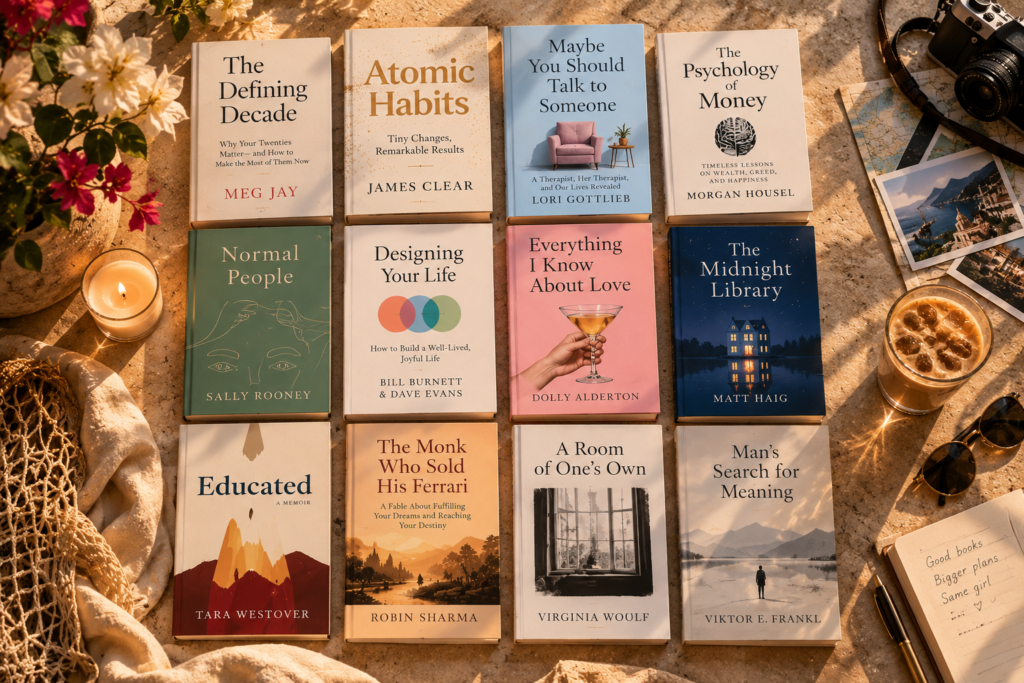
12 Books Worth Reading in Your 20s
1. The Defining Decade — Meg Jay
Best for: Finding direction without panicking about the future.
Clinical psychologist Meg Jay explores why the decisions and experiences of your twenties can have a meaningful influence on later life.
Drawing on her clinical experience and psychological research, she discusses relationships, careers, identity, and the importance of building what she calls “identity capital.”
The book challenges the idea that your twenties are simply a waiting period before real adulthood begins. However, its message is best approached as encouragement to act intentionally — not as a warning that you must achieve everything before turning thirty.
Why read it now: It can motivate you to explore opportunities and make thoughtful choices without expecting yourself to have a perfect plan.
2. Atomic Habits — James Clear
Best for: Building routines that support the life you want.
Big goals are exciting. Maintaining the everyday habits needed to reach them is usually much harder.
In Atomic Habits, James Clear explains how small, repeated actions can accumulate into meaningful changes over time. He explores practical ideas such as making desired behaviors easier, changing your environment, and focusing on systems rather than motivation alone.
Whether you’re trying to exercise regularly, read more, manage your time, or develop professional skills, the book offers useful strategies.
Why read it now: Your twenties are a great time to experiment with routines that fit your personality and lifestyle.
3. Maybe You Should Talk to Someone — Lori Gottlieb
Best for: Understanding your emotions and relationships.
Psychotherapist Lori Gottlieb shares stories from her work with patients while also describing her own experience in therapy.The result is a surprisingly funny and moving exploration of heartbreak, vulnerability, grief, and the stories we tell ourselves.
One of its strongest messages is that self-awareness doesn’t mean having everything figured out.Even people who understand human behavior professionally can struggle to recognize their own patterns.
Why read it now: It encourages emotional honesty and shows why asking for help can be part of personal growth.
4. The Psychology of Money — Morgan Housel
Best for: Developing a healthier relationship with money.
Personal finance can feel overwhelming when you’re just beginning to earn, save, or invest.
Morgan Housel approaches money from a behavioral perspective, exploring why financial decisions are often influenced by emotions, experiences, and personal expectations. Rather than presenting complicated formulas, he uses stories to discuss patience, risk, wealth, and the difference between being rich and staying financially secure.
The book isn’t a substitute for personalized financial advice, but it offers a valuable foundation for thinking about money.
Why read it now: Understanding your financial behavior early can help you make more intentional choices as your circumstances change.
5. Normal People — Sally Rooney
Best for: Anyone navigating complicated relationships and identity.
Connell and Marianne grow up in the same Irish town but occupy very different positions in their school’s social world. As their relationship evolves through university and early adulthood, they struggle with communication, vulnerability, social expectations, and their changing identities.
Sally Rooney captures the uncomfortable reality that two people can care deeply about each other and still misunderstand one another. It’s a quiet, emotionally complex novel rather than a traditional love story.
Why read it now: It explores how relationships can shape our confidence, self-image, and understanding of intimacy.
6. Designing Your Life — Bill Burnett and Dave Evans
Best for: Feeling stuck about your career or future.
What if choosing a career didn’t have to mean finding one perfect path?
Drawing on design-thinking methods, Bill Burnett and Dave Evans encourage readers to approach life decisions through curiosity, experimentation, and reflection. Instead of waiting for absolute certainty, they suggest testing possibilities, speaking with people who do interesting work, and imagining multiple fulfilling futures.
The book also includes exercises that make its ideas easier to apply.
Why read it now: It’s particularly useful when you’re considering changing careers, pursuing further education, or exploring an unconventional direction.
Books About Identity, Courage, and Finding Your Place
Growing up isn’t only about becoming financially independent or choosing a profession. It’s also about learning which expectations you want to keep, which beliefs deserve questioning, and how to build a life that feels genuinely yours.
7. Everything I Know About Love — Dolly Alderton
Best for: Friendship, heartbreak, and the messy reality of growing up.
In this memoir, Dolly Alderton reflects on dating, friendships, parties, mistakes, and the sometimes chaotic experience of becoming an adult. Although romantic relationships play a role, the book’s emotional center is often friendship.
Alderton writes with humor and honesty about the people who support us through changing circumstances and uncertain years.
Why read it now: It’s a reminder that meaningful love comes in many forms — and that friendships deserve just as much attention as romance.
8. The Midnight Library — Matt Haig
Best for: Letting go of regret and constant comparison.
Nora Seed finds herself in a mysterious library where each book offers a glimpse into a life she might have lived if she’d made different choices.
Through these alternate possibilities, the novel explores regret, disappointment, and the temptation to believe everyone else’s life is better. Its premise feels especially relevant in an age of social media, where it’s easy to compare your everyday reality with someone else’s highlights.
The story includes themes of depression and suicide.
Why read it now: It challenges the belief that there’s only one correct path to happiness.
9. Educated — Tara Westover
Best for: Questioning expectations and defining your own identity.
Tara Westover grew up in a survivalist family in rural Idaho with limited access to formal education. Her memoir follows her journey toward university and the difficult process of developing an identity beyond the beliefs and expectations she inherited.
Educated explores family loyalty, personal independence, knowledge, and the emotional cost of changing your worldview.
Why read it now: It encourages readers to think about the difference between respecting their upbringing and allowing it to determine every future choice.
10. The Monk Who Sold His Ferrari — Robin Sharma
Best for: Rethinking success, finding balance, and discovering what truly matters.
What if everything you’ve worked so hard to achieve isn’t actually making you happy?
In The Monk Who Sold His Ferrari, Robin Sharma tells the story of Julian Mantle, a highly successful lawyer whose demanding lifestyle eventually leads him to question everything he once considered important. After a personal crisis, Julian leaves behind his luxurious possessions and travels to India in search of a more meaningful life.
Through his journey, the book explores mindfulness, self-discipline, personal growth, and the importance of finding balance between ambition and inner peace. Written as an inspirational fable, it offers philosophical lessons and practical suggestions rather than scientific evidence.
Why read it now: Your twenties are the perfect time to question what success means to you — before spending years chasing a version of it that might not make you happy.
11. A Room of One’s Own — Virginia Woolf
Best for: Creativity, independence, and understanding opportunity.
Based on lectures delivered in 1928, Virginia Woolf’s extended essay examines the relationship between women, literature, money, and intellectual freedom. Woolf argues that creative independence requires more than talent. It also depends on access to resources, privacy, education, and opportunity.
Although written nearly a century ago, the essay remains relevant to conversations about gender, work, and who gets the space to create.
Why read it now: It encourages you to think about the practical conditions needed to pursue your ambitions.
12. Man’s Search for Meaning — Viktor E. Frankl
Best for: Reflecting on purpose and resilience.
Viktor Frankl, a psychiatrist and Holocaust survivor, reflects on his experiences in Nazi concentration camps and the search for meaning under extreme suffering. The book also introduces his therapeutic approach, logotherapy, which emphasizes the importance of meaning in human life.
It’s a difficult and deeply serious read, but one that has influenced generations of readers. Frankl’s experiences should not be reduced to simple motivational lessons. Their historical reality deserves care and respect.
Why read it now: It invites reflection on what gives your life meaning beyond achievement, status, or other people’s expectations.

Which Book Should You Start With?
If you’re feeling uncertain about your future, begin with Designing Your Life or The Defining Decade.
If you want to improve your routines or financial decisions, try Atomic Habits or The Psychology of Money.
For relationships, friendship, and emotional growth, Normal People, Everything I Know About Love, and Maybe You Should Talk to Someone offer very different but valuable perspectives.
And if you’re questioning your identity or the expectations placed on you, consider Educated, A Room of One’s Own, or The Courage to Be Disliked.
You don’t need to read all twelve this year. Start with the one that feels relevant to your life right now.
“You don’t need to have your entire future figured out to make a meaningful decision today.”
Final Thoughts: Your 20s Are for Learning, Not Just Achieving
It’s easy to treat your twenties like a race. A race toward the right career, the perfect relationship, financial stability, or some imagined version of adulthood where everything finally makes sense. But growing up rarely happens in a straight line.
You might change your mind, start over, discover a new passion, or realize that a goal you once wanted no longer fits the person you’re becoming. And that’s okay.
The books on this list won’t give you a flawless roadmap. What they can offer is perspective, encouragement, and the reminder that a meaningful life is built through curiosity, reflection, and experience.
What book do you wish you’d discovered earlier in your twenties? Share your recommendation in the comments.
Leave a Reply