


Have you ever finished a book and realized you were looking at the world a little differently?
Maybe it made you appreciate something you had been taking for granted. Maybe it challenged a belief you had never questioned. Or perhaps it simply gave you the words for a feeling you couldn’t explain before.
“Some books entertain us. Others stay in our minds long after we turn the final page.”
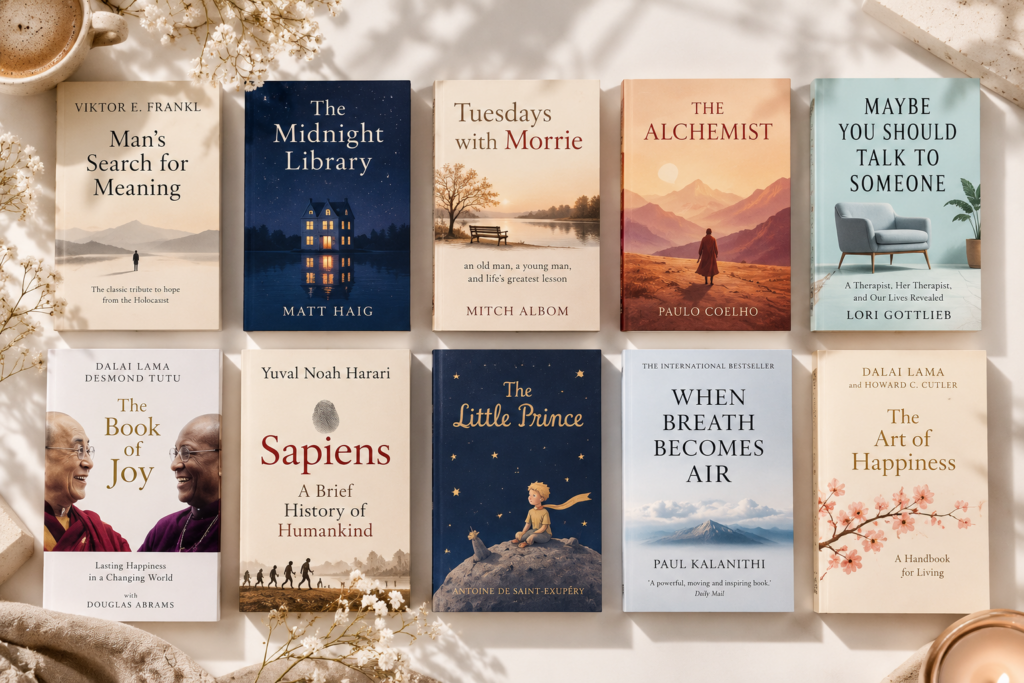
The books on this list explore everything from happiness and human connection to mortality, freedom, and the way our minds work. They aren’t guaranteed to transform your life overnight, but each offers something worth thinking about.
And sometimes, a new perspective is exactly what we need.
Why Some Books Change the Way We Think
Reading allows us to experience situations and perspectives far beyond our own lives.
A novel can introduce us to someone whose choices we don’t understand at first. A memoir can reveal the reality behind experiences we’ve only heard about. And a thoughtful nonfiction book can make us question habits that once seemed completely normal.
The most meaningful books don’t necessarily give us answers. Often, they leave us with better questions.
“Sometimes the most powerful thing a book can change isn’t your life. It’s the way you understand it.”
10 Books That Will Make You See Life Differently
1. Man’s Search for Meaning — Viktor E. Frankl
A powerful reflection on finding meaning in difficult circumstances.
Viktor Frankl was an Austrian psychiatrist and Holocaust survivor who wrote about his experiences in Nazi concentration camps and his psychological approach to finding meaning in life.
Man’s Search for Meaning explores the idea that even when we cannot control our circumstances, our response to them can still matter.
What makes this book remarkable is its combination of personal testimony and psychological reflection. Frankl doesn’t offer easy optimism or pretend suffering is inherently meaningful. Instead, he asks how people can find purpose despite hardship.
What it might change: The way you think about resilience, purpose, and what gives life meaning.
2. The Midnight Library — Matt Haig
For anyone who has ever wondered, “What if I’d chosen differently?”
Nora Seed feels overwhelmed by regret. When she finds herself in a mysterious library between life and death, she discovers that every book offers a chance to experience a different version of her life.
What if she had pursued another career? Stayed in a relationship? Made completely different decisions?
Through Nora’s experiences, Matt Haig explores the pressure to live a perfect life and the exhausting habit of comparing reality with imagined alternatives.
The novel also addresses depression and suicidal thoughts, so readers may want to consider those themes before picking it up.
What it might change: Your relationship with regret and the belief that another version of your life would necessarily be better.
3. Tuesdays with Morrie — Mitch Albom
A gentle reminder of what really matters.
After reconnecting with his former college professor, Morrie Schwartz, journalist Mitch Albom begins visiting him on Tuesdays.
Morrie is living with ALS, a progressive neurological disease, and their conversations become lessons about love, work, family, aging, and death.
Rather than focusing on extraordinary achievements, the book finds meaning in ordinary human connections.
Its message is simple but easy to forget in a world that constantly encourages us to do more, earn more, and become more successful.
What it might change: How you define a successful life and how much attention you give to the people around you.
4. The Alchemist — Paulo Coelho
A philosophical adventure about dreams, courage, and personal purpose.
Santiago is a young shepherd who leaves his familiar life behind to pursue a recurring dream about treasure.
His journey takes him across unfamiliar landscapes and introduces him to people who challenge his understanding of destiny, fear, and possibility.
The Alchemist reads like a modern fable. Its symbolism and spiritual themes won’t appeal to everyone, but its central question is compelling: how much of our lives do we spend avoiding the things we genuinely want?
What it might change: The way you approach uncertainty, ambition, and the fear of taking a different path.
5. Maybe You Should Talk to Someone — Lori Gottlieb
An honest, funny, and moving look at being human.
Lori Gottlieb is a psychotherapist who finds herself seeking therapy after an unexpected personal crisis.
The book follows both her own experience as a patient and the stories of several people she treats, with identifying details changed to protect privacy.
Through these interconnected narratives, Gottlieb explores grief, relationships, self-deception, vulnerability, and the stories we tell ourselves.
One of the book’s greatest strengths is its reminder that even people who seem to have everything figured out can struggle.
What it might change: How you view therapy, emotional vulnerability, and your own patterns of thinking.
A Different Perspective on Happiness and Everyday Life
Not every life-changing book deals with dramatic events.
Sometimes, a small shift in how we think about happiness, time, or other people can have a lasting influence on our daily choices.
The next five books approach those questions from very different directions.
6. The Book of Joy — Dalai Lama, Desmond Tutu and Douglas Abrams
A conversation about finding joy despite life’s difficulties.
This book documents a week of conversations between the Dalai Lama and Archbishop Desmond Tutu, brought together with writer Douglas Abrams.
Both spiritual leaders experienced political conflict, displacement, and personal hardship, yet their discussions are filled with humor and warmth.
They explore the difference between temporary pleasure and a deeper sense of joy, while considering the roles of compassion, gratitude, and human connection.
What it might change: Your understanding of happiness and the idea that joy requires a problem-free life.
7. Sapiens: A Brief History of Humankind — Yuval Noah Harari
A sweeping look at how human societies came to be.
Why do people believe in money? How did agriculture reshape civilization? What makes humans capable of cooperating in enormous groups?
In Sapiens, historian Yuval Noah Harari explores human history through biology, economics, religion, and social organization.
The book encourages readers to question institutions and assumptions that often feel natural or inevitable.
Some of Harari’s broad historical interpretations are debated by scholars, so it’s best approached as a provocative introduction rather than a definitive account.
What it might change: The way you understand society, cultural beliefs, and the systems shaping everyday life.
8. The Little Prince — Antoine de Saint-Exupéry
A short story with surprisingly big questions.
At first glance, The Little Prince looks like a children’s book about a young prince traveling between planets.
But beneath its simple illustrations and imaginative encounters lies a thoughtful exploration of friendship, loneliness, love, and growing up.
As the prince meets adults obsessed with status, numbers, and authority, the story gently questions the priorities we develop as we get older.
It’s the kind of book that can feel completely different depending on when you read it.
What it might change: Your appreciation for relationships, imagination, and the things that cannot be measured.
9. When Breath Becomes Air — Paul Kalanithi
A deeply personal memoir about life, medicine, and mortality.
Paul Kalanithi was a neurosurgeon approaching the end of his training when he was diagnosed with advanced lung cancer.
Suddenly, he found himself navigating the experience of serious illness from the other side of the doctor-patient relationship.
His memoir reflects on identity, ambition, family, and the question of what makes life meaningful when the future becomes uncertain.
It is an emotional read, but its power comes from its honesty rather than easy inspirational messages.
What it might change: The way you think about time, priorities, and what makes a life worthwhile.
10. The Art of Happiness — Dalai Lama and Howard C. Cutler
A practical exploration of happiness as a way of thinking.
Psychiatrist Howard Cutler draws on conversations with the Dalai Lama to explore compassion, suffering, relationships, and mental well-being.
Instead of presenting happiness as a reward for achieving the right goals, the book considers how attitudes and everyday practices can influence our experience of life.
Its approach combines Buddhist philosophy with Cutler’s reflections as a psychiatrist.
Readers don’t need to share the Dalai Lama’s spiritual beliefs to find questions worth considering here.
What it might change: How you think about contentment, compassion, and the habits that shape your emotional life.

How to Choose the Right Book for You
You don’t need to read all ten books to discover something meaningful.
If you’re questioning your direction in life, start with Man’s Search for Meaning or The Alchemist.
If you find yourself constantly replaying past decisions, The Midnight Library might speak to you.
For a deeper understanding of relationships and emotions, try Maybe You Should Talk to Someone or Tuesdays with Morrie.
And if you want to challenge the way you understand the world itself, Sapiens is an interesting place to begin.
The best choice isn’t necessarily the most famous book. It’s the one that connects with the questions you’re asking right now.
“You don’t always need a completely new life. Sometimes you need a new way of looking at the one you already have.”
Final Thoughts: One Book Can Start a New Conversation
A meaningful book doesn’t have to change everything about you.
Sometimes its influence is quiet. You might become a little more patient, reconsider an old assumption, or appreciate an ordinary moment you would otherwise have overlooked.
The books on this list offer different perspectives, and you may not agree with every idea they present. That’s part of what makes reading valuable.
You can question an author’s conclusions, reflect on your own experiences, and decide what deserves a place in your life.
Which book has changed the way you see the world? We’d love to hear your recommendation.
Leave a Reply