
Sometimes the most unforgettable stories are the ones that actually happened.
A novel can transport us to another world, but a book rooted in real events carries a different kind of emotional weight. Knowing that real people experienced extraordinary circumstances, made impossible decisions, or fought against overwhelming odds can make a story even more powerful.
Of course, not every book inspired by real events is entirely factual. Some authors reconstruct history through fictional characters, while others share their experiences through memoirs or carefully researched nonfiction.
From remarkable survival stories to historical fiction inspired by real people, here are ten books based on true stories and real events that deserve a place on your reading list.
Why Are Books Based on True Stories So Compelling?
There’s something special about discovering the human experiences behind major historical events. A history textbook might explain when something happened. A personal story helps us imagine what it felt like to live through it.
Books rooted in reality also remind us that extraordinary experiences often begin with ordinary people. They explore courage, grief, survival, ambition, and the complicated choices people make under pressure. Some stories inspire us. Others challenge our assumptions or reveal uncomfortable truths about the world.
“Real events give a story its history. The people inside it give that history a heartbeat.”
10 Unforgettable Books Inspired by Real Life
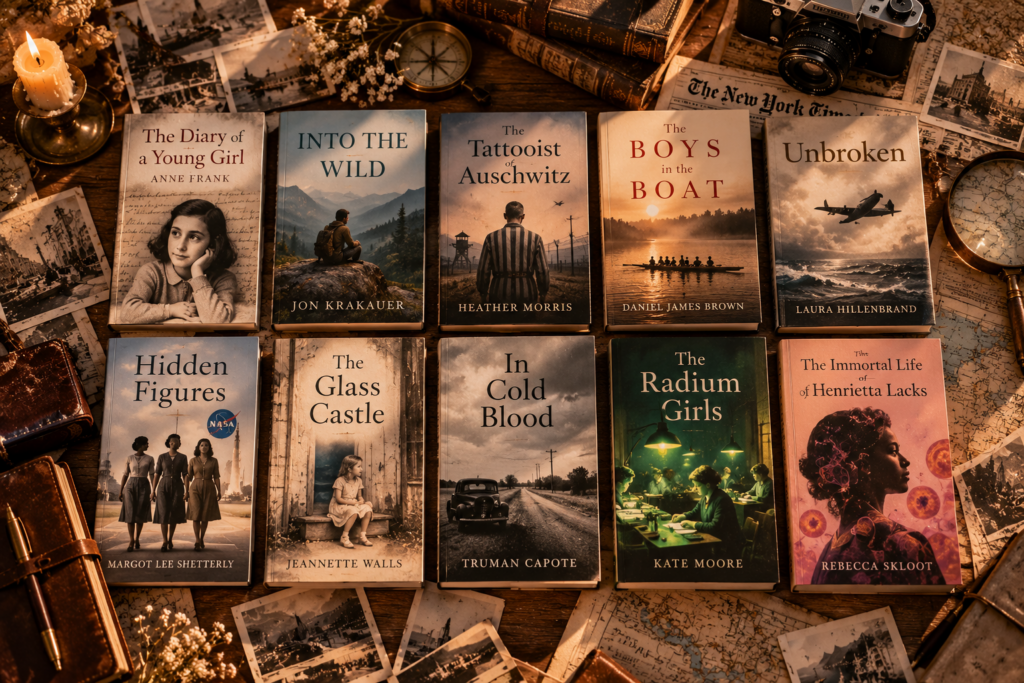
1. The Diary of a Young Girl — Anne Frank
Genre: Diary / Historical nonfiction
Based on: Anne Frank’s writings while hiding from Nazi persecution during World War II.
Anne Frank was a Jewish teenager who kept a diary while hiding with her family and others in a secret annex in Amsterdam. Her writing captures the daily frustrations, hopes, fears, and emotional changes of adolescence under extraordinary circumstances.What makes the diary especially moving is Anne’s personality. She’s thoughtful, funny, observant, and sometimes frustrated with the people around her.
Readers encounter not only a historical victim but a young person with dreams, opinions, and an unmistakable voice.
Why read it: It offers a deeply personal perspective on the Holocaust and the life of a young girl whose future was stolen.
2. Into the Wild — Jon Krakauer
Genre: Narrative nonfiction / Adventure
Based on: The life and death of Christopher McCandless.
In the early 1990s, Christopher McCandless left behind many of the expectations associated with conventional success and began traveling across the United States. Eventually, he ventured into the Alaskan wilderness, where his journey ended tragically.
Jon Krakauer investigates McCandless’s decisions, motivations, and relationships while exploring broader questions about freedom, idealism, and risk.
The book doesn’t offer a simple answer about whether McCandless was courageous, reckless, or misunderstood.
Why read it: It encourages reflection on independence, adventure, and the complicated difference between romanticizing nature and understanding its dangers.
3. The Tattooist of Auschwitz — Heather Morris
Genre: Historical fiction
Inspired by: The experiences of Holocaust survivor Lale Sokolov.
Heather Morris’s bestselling novel follows Lale, a Jewish prisoner forced to work as a tattooist at Auschwitz-Birkenau. Amid the brutality of the concentration camp, he meets Gita, another prisoner, and a relationship develops.
The story is inspired by interviews with Lale Sokolov, but it is a fictionalized narrative rather than a fully reliable historical record.
Historians and the Auschwitz-Birkenau Memorial have identified significant inaccuracies in the novel, so readers should not treat every scene as documented fact.
Why read it: It offers an emotionally engaging story that can encourage further learning about Holocaust history, provided its fictional elements are understood.
4. The Boys in the Boat — Daniel James Brown
Genre: Historical nonfiction / Sports biography
Based on: The University of Washington rowing team’s journey to the 1936 Berlin Olympics.
In the middle of the Great Depression, nine young American rowers set out to achieve something extraordinary. Many came from working-class backgrounds and faced significant financial and personal challenges. Their determination eventually took them to the 1936 Olympic Games in Nazi Germany, where they competed against some of the world’s strongest rowing teams.
Daniel James Brown brings their journey to life through historical research, personal stories, and vivid descriptions of the physical and mental demands of competitive rowing.
At the heart of the book is the idea that individual talent means little without trust, discipline, and teamwork.
Why read it: It’s an inspiring true story about perseverance, friendship, and what people can accomplish when they learn to work together.
5. Unbroken — Laura Hillenbrand
Genre: Biography / Narrative nonfiction
Based on: The life of Olympic runner and World War II veteran Louis Zamperini.
Louis Zamperini’s life reads like an adventure novel. After competing in the 1936 Olympics, he served in the United States Army Air Forces during World War II. When his plane crashed into the Pacific Ocean, he survived an extraordinary ordeal at sea before being captured and held as a prisoner of war.
Laura Hillenbrand reconstructs his experiences through extensive research and interviews.
Why read it: It’s a gripping account of survival, endurance, and the long-lasting effects of war.
Stories of Survival, Courage, and Extraordinary Lives
Some of the most memorable true stories focus on people facing circumstances they never expected.
Others reveal overlooked parts of history or challenge the way we understand events we thought we already knew.
The next five books approach reality through very different perspectives.
6. Hidden Figures — Margot Lee Shetterly
Genre: Historical nonfiction
Based on: The work of Black women mathematicians at NASA and its predecessor, NACA.
Long before electronic computers became essential to space exploration, human mathematicians performed the calculations that made major aerospace achievements possible.
Hidden Figures tells the stories of Black women whose work contributed to American aviation and space research. It also examines the racial segregation and gender discrimination they faced while pursuing their careers.
Unlike the fictionalized film adaptation, Shetterly’s book provides a broader historical account of the women and the institutions in which they worked.
Why read it: It reveals an important part of scientific history and celebrates achievements that were too often overlooked.
7. The Glass Castle — Jeannette Walls
Genre: Memoir
Based on: Jeannette Walls’s childhood and family experiences.
Jeannette Walls grew up in a family marked by instability, poverty, and unconventional parenting. Her father was imaginative and charismatic but struggled with alcoholism. Her mother valued artistic freedom, sometimes at the expense of practical responsibilities.
Through vivid memories, Walls explores the complicated relationship between love and neglect. The book is striking because it resists reducing its family members to simple heroes or villains.
Why read it: It’s an honest exploration of childhood resilience, family loyalty, and the lasting influence of upbringing.
8. In Cold Blood — Truman Capote
Genre: True crime / Literary nonfiction
Based on: The 1959 murders of the Clutter family in Kansas.
Truman Capote investigates the murder of four members of the Clutter family and the lives of the men responsible.
Combining reporting with literary storytelling techniques, In Cold Blood became one of the most influential works of narrative true crime.
However, its reconstructed scenes and dialogue have also raised questions about factual accuracy and the boundaries between journalism and storytelling.
Why read it: It’s an important work for readers interested in crime, psychology, and the ethical complexities of true-crime writing.
9. The Radium Girls — Kate Moore
Genre: Historical nonfiction
Based on: The experiences of women exposed to radioactive paint while working in American factories.
In the early 20th century, young women were employed to paint watch and clock dials using luminous radium-based paint. Many workers were encouraged to shape their paintbrushes with their lips, unknowingly exposing themselves to a dangerous radioactive substance. As serious illnesses emerged, some of the women fought for recognition, accountability, and justice.
Kate Moore tells their stories while examining workplace safety and corporate responsibility.
Why read it: It’s a disturbing but important account of courage and the human cost of industrial negligence.
10. The Immortal Life of Henrietta Lacks — Rebecca Skloot
Genre: Science / Biography / Narrative nonfiction
Based on: The life of Henrietta Lacks and the history of HeLa cells.
In 1951, cancer cells were taken from Henrietta Lacks, a Black woman receiving treatment at Johns Hopkins Hospital. Those cells became the first widely successful immortal human cell line, known as HeLa, and played a major role in medical research. But Henrietta’s family did not initially know about the cells’ extensive scientific use.
Rebecca Skloot explores the extraordinary scientific legacy alongside questions of consent, race, medical ethics, and family history.
Why read it: It reveals the human story behind a major scientific development and raises essential questions about who benefits from medical progress.
Historical Fiction vs. True Stories: What’s the Difference?
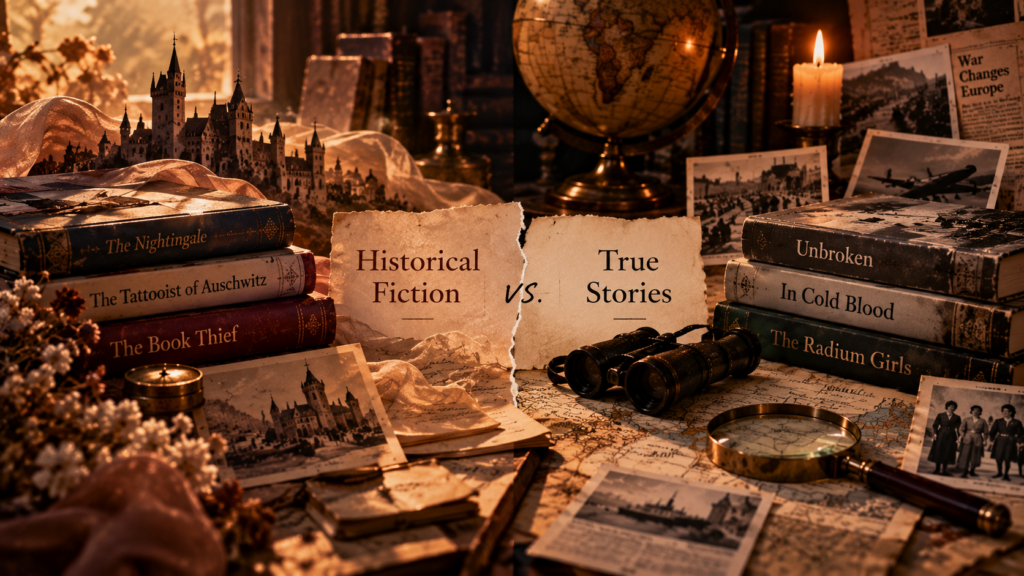
Not every book described as “based on a true story” should be read in the same way.
Memoirs present an author’s recollections of their own life. They offer personal testimony, although memory and perspective can influence how events are described.
Narrative nonfiction uses reporting, interviews, and historical research to tell factual stories in an engaging way.
Historical fiction places invented or fictionalized narratives within real historical settings. It may draw inspiration from actual people, but dialogue, events, and characters can be altered.
Understanding these differences helps readers appreciate a book without mistaking every dramatic scene for established history.
Which Book Should You Read First?
If you’re interested in World War II history, start with The Diary of a Young Girl or Unbroken.
For an inspiring story about determination and teamwork, The Boys in the Boat is an excellent choice.
If you enjoy science and overlooked historical figures, try Hidden Figures or The Immortal Life of Henrietta Lacks.
For darker investigative nonfiction, In Cold Blood offers an influential example of literary true crime.
And if you love stories of people challenging powerful institutions, The Radium Girls is particularly memorable.
“Sometimes the most extraordinary part of a story is discovering that someone really lived it.”
Final Thoughts: Real Stories Stay With Us
Books inspired by real events offer more than entertainment.
They can introduce us to people whose experiences differ dramatically from our own, reveal forgotten histories, and encourage us to question the stories society chooses to remember.
Some are inspiring. Others are heartbreaking or deeply uncomfortable.
But each reminds us that history is not only made up of dates, statistics, and famous names. It’s made up of individual lives.
And those lives deserve to be understood with curiosity, empathy, and care.
What’s the most unforgettable true story you’ve ever read? Share your recommendation in the comments.
Leave a Reply